
Scotts CA Logo

News

6 steps to create a mentally healthy and vibrant workplace

It’s estimated we spend a third of our life at work. It may even be more if you run your own small business. From working overtime during the week to catching up on paperwork on the weekend, having enough time to get everything done is a challenge for most small businesses.

.

So, it’s easy to understand why you might not feel like you have the time to think about your own wellbeing let alone the wellbeing of your employees or your co-workers. However, understanding how the people in your business are coping with both life and work pressures is just as important as paying your suppliers every week or doing a stocktake.

45% of Australians experience a mental health problem at least once in their lifetime.

In 2022, 52% of serious mental stress claims in Australia were because of work-related issues. These issues included harassment, bullying, work pressure and occupational violence.

Poor workplace wellbeing affects workers’ mental health and productivity, costing our economy up to $22.5 billion a year. Asking a colleague ‘R U OK?’ may begin a conversation that not only helps them but also helps build a healthy workplace.

This year, R U OK? Day is on Thursday 12 September 2024. The day serves as a reminder that asking, ‘are you ok’ any day of the year is important to the mental health and wellbeing of those around you.

One way to improve workplace wellbeing, safety, and performance is to use Dr Martin Seligman’s (2012) PERMAH framework. This evidence-based model highlights 6 factors that help us feel good and perform well at work. Workplace culture can be improved by prioritising these 6 elements.
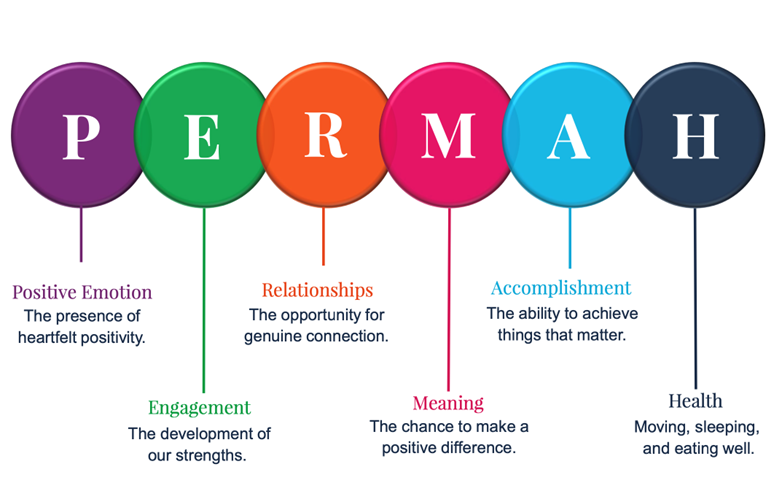
A graphic showing the PERMAH Framework.

1. Positive emotions: ‘AMP’ up your understanding of stress


A healthy workplace is not absent of stress, but it is one where people know how to manage it. Stress is natural, especially if you run your own small business. Often, it’s our body’s way of trying to alert us that something we care about is at stake.

By noticing the signs of stress in yourself and your employees, Associate Professor of Psychology at Standford University Dr Alia Crum, found we can harness our body’s stress responses to help us meet life with the energy and courage we need to deal with whatever is at stake.

You can help your workplace ‘AMP’ up an understanding of stress by encouraging your people to:

Be Aware when they feel stressed, that their body is trying to get their attention by making them feel uncomfortable (sweaty hands, racing heart, tight jaw or hunched shoulders).
Find Meaning for these feelings by asking them what's happening that's important and may not be going the way they want.
Prioritise Conversations and/or actions that can positively impact the outcome of what's unfolding. Remember, tiny steps can have a mighty impact because they motivate people to move forward with confidence.
Whether you’re a sole trader or run a small team, understanding the signs of stress can help keep you and your employees in a positive frame of mind. Sometimes stress can’t be avoided, but we can manage how that stress affects us and do things to help reduce it.

2. Engagement: give strength-focused feedback


High-performing teams share nearly 6 times more positive feedback than average teams, while low-performing teams share nearly 2 times as much negative feedback as average teams. Make giving strength-focused feedback to your employees a priority, and easier and more effective by using the ‘THANK’ method:

Track: What is the positive impact you’ve seen this person’s work having recently on others? How specifically might they be making work or life easier or better?
Highlight: What can you see them learning, doing, and/or delivering that is making this positive difference that you value?
Appreciate: What strengths – the things they are good at and enjoy doing – can you see being used to make this effort and/or outcomes possible?
Nurture: How can these strengths be built on? How might they avoid overplaying or underplaying their strengths that could help improve their performance?
Kindle: What support might they need/want and what does this look like?


3. Relationships: build psychological safety


Vibrant workplaces welcome honesty, prioritise learning, encourage asking for help, and support taking risks together. Everyone struggles at work from time to time. Workplaces that normalise the feeling of struggling can promote healthy learning and growth.

Removing any barriers or embarrassment to having open conversations can help unlock the potential for people to become better at their jobs. Psychological safety can be built by using the following Safety Check Chat questions to check in with your team:

What’s working well?
Where are we struggling?
What are we learning?
What do we want to try next?
Four people in an office sitting at their desks, laughing on a coffee break.

 

Four people in an office sitting at their desks, laughing on a coffee break.

4. Meaning: create a giving culture


We long to be more than the sum of the tasks we perform at work. The good news is researchers have found that meaning can be found in any job by helping people identify the difference their work makes to others. Encourage a healthy workplace by getting people to invest in 5-minute favours that make a positive difference in someone else’s life by:

offering to help with a hands-on task
sharing their expertise (i.e. offering their skills)
coaching or mentoring others (i.e. teaching someone how)
passing on favourite resources (i.e. books, podcasts, articles, recommendations)
supporting a colleague by listening to their struggles and/or successes.


5. Accomplishment: setting and celebrating learning goals


A vibrant workplace is one that learns and understands failure and mistakes are part of how things are accomplished. They do this by embracing a ‘growth mindset’ that recognises that while we all bring to the workplace certain talents, abilities, and intelligence we can improve upon these with learning, practice, and support. To help your team develop their growth mindsets you can ‘SET’ learning goals:

Spark your curiosity: Challenge your mind by picking a small learning goal that can make a big difference.
Experiment: Act on your learning goal within the next 24–48 hours. Remember as long as you show up, give your goal your best shot, and stay curious about the results, you can’t fail.
Tune into feedback: Measure your progress, seek feedback, and reflect on what you’re learning to move closer to your goals.


6. Physical health: the need for rest and recovery


Vibrant workplaces recognise we are built to swing between periods of activity and recovery. They understand the power of short breaks throughout the day. In turn, this helps people stay energised, healthy and more productive.

Recovery doesn’t mean you need to take a nap in the backroom or under your desk. Researchers have found that short breaks allow the thinking parts of our brains to rest. This can be just as effective as naps. Here are some easy ways to add these to your workplace:

Encourage ‘walk and talk’ meetings/discussions where possible.
Encourage shared lunch breaks, eating together away from desks or finding an external lunch location.
Provide exercise cards/posters for quick stretches between tasks.
Organise fun workplace challenges that encourage activity and involvement, e.g. a sit-stand challenge to see who can hold the position the longest.
Allow short social breaks like tea/coffee conversations, which help rest the brain and build connections between employees.
How to create change in the workplace
Business owners and leaders may face challenges when trying to bring about behaviour changes. Professor James Prochaska, (a leading researcher in behaviour change), highlights that there are 3 common derailers when it comes to caring for our wellbeing. These include:

‘I don’t want to’
‘I don’t know how to’
‘I don’t think I can’.
Creating safe places for people to learn and grow can be a strategic way to help overcome these barriers. Business owners can do this by tapping into curiosity rather than judgment, as well as encouraging their employees to switch their mindset about how to deal with people:

Instead of making assumptions, slow down and ask questions to understand.
Rather than being embarrassed to ask questions, assume learning is helpful and seek/offer support.
Instead of complaining about someone’s performance, assume everyone is capable and spark kind conversations to enable growth.
Rather than pointing the finger and blaming others, encourage shared responsibility and create transparent and safe spaces for accountability.
Building a vibrant workplace culture is an ongoing process requiring long-term strategies. A learning loop can be helpful to enable continuous improvement:

Act: What have you tried? Why did it matter to you?
Assess: What went well? where did you struggle? What did you learn?
Adjust: What will you try next? Do you need support?
Building a healthy and vibrant workplace isn’t something that can be done overnight or something that you must do by yourself. It’s done by encouraging a workplace culture of positive behaviours every day. It’s the small things that count in the end. Researchers suggest that small and consistent ‘wellbeing wins’ amplify our confidence and motivation so we can scale up our efforts over time.

Small changes can have big results
In a vibrant workplace, people feel safe, energised, and ready to collaborate. They’re resilient and productive, navigating both highs and lows as part of learning and growing together. Ask yourself, are you creating and leading a vibrant workplace culture?

Start implementing the frameworks and wellbeing strategies above. Your proactive commitment to making even one small change today can make a meaningful difference both now and in the future.

Let’s make R U OK? Day the opportunity to not just ask this vital question, but to create sustainable and vibrant work environments where wellbeing is prioritised and businesses perform at their best. For more information on R U OK? Day, visit the R U OK website.

For more information on building resilient people, healthy relationships and vibrant workplaces, visit the Wellbeing Lab website.

Tools to improve your workplace’s mental health
Work Safe Victoria’s mental health: safety basics
The Victorian Mentally Healthy Workplaces Framework | vic.gov.au (www.vic.gov.au)
Mental health support services
Mental health support and assistance services
Free support and advice with Partners in Wellbeing


THE WELLBEING LAB
12 SEP 2024
business.vic.gov.au



Hot Issues

David Scott

David Scott

Tertiary Education : Bachelor of Business (Accounting) at RMIT

Qualifications: Chartered Accountant & Diploma of Financial Planning

Professional Memberships: Institute of Chartered Accountants (CAANZ)

David began his professional career in 1978 where he worked for 9 years at a mid-tier chartered accounting firm in Melbourne while studying at RMIT. David’s ambition drove him back to Geelong in 1987 where he decided to establish his own practice.

Since 1987 David has operated under various brands including Hetherington and Scott, Scott & Co, SCC and in 2009 David rebranded the business to Scotts Chartered Accountants. In 2022 David celebrated a milestone achieving 35 years in business and it has been his innovation, determination and desire for constant improvement that has made the firm what it is today. David is a small business and SMSF tax specialist and a qualified financial planner. He recognises the need to adapt to the needs of clients and strongly believes in the phase, 'knowledge is power'.

Along the way he has developed a team of proactive and like minded professionals who he thoroughly enjoys working with. The business relocated to Sladen House several years in 2010 and the history of the building combined with the location and renovation works makes it an incredible place to work. David says, "We have strived to develop some serious points of difference compared to other accounting firms in terms of the services we deliver but our offices add to that story. Business owners want an accountant who does more than just keep the score and we aim to help our clients grow their business, their profits and their wealth."

Outside of the business, David is an avid runner completing multiple half and full marathons including running a marathon on all seven continents and undertaking adventure travel such as Everest Base Camp, Mount Kilimanjaro, Kokoda trail and Marathon Des Sables.

Larry Caravallo

Larry Cavallo

Larry started his professional accounting career in 2001 after completing a double degree at the University of South Australia - Bachelor of Commerce and Bachelor of Finance.

After working for an Adelaide based accounting firm for several years he joined the team at Scotts in 2005. He primarily works on small business clients where he’s responsible for the preparation of financial statements, tax returns and Business Activity Statements. His love for the accounting profession comes from a desire to help clients succeed by providing them with tax, accounting and financial advice to help them reach their goals.

Larry is passionate about small business and is committed to helping clients. “Our brief includes helping business owners improve their bottom line profit, minimise their tax exposure and create wealth for retirement. To succeed in business you need timely, quality advice plus you need to make the right choices.”

Professional Qualifications & Memberships

Larry describes the best part about working with Scotts is, “The great team who are friendly and caring. Awesome office facilities and a great boss.”

Outside the office Larry has four young children who keep him on his toes and he enjoys helping out in their sporting pursuits including netball, soccer and AFL Auskick. Larry loves his golf and is on the golf course at every available opportunity fine-tuning his skills. He also enjoys gardening and growing his own vegetables.

Jessica Markewicz

Jessica Markewicz

Education (Secondary): North Geelong Secondary College

Education (Tertiary): Deakin University

Qualifications: Chartered Accountant, Bachelor of Commerce majoring in Accounting and Financial Planning

Professional memberships / associations: Institute of Chartered Accountants (ICAA) and Registered Tax Agent

Jess started her professional life as an accountant for a small business based in Ocean Grove whilst completing her accounting degree here at Geelong Deakin University. This provided a great insight to running a small business as well as training and experience while studying. She joined the team at Scotts in 2005 after finishing her degree. She primarily works with business clients, managing and looking after all the needs of her portfolio of clients, including their annual tax compliance, tax planning, business development such as business plans and day to day queries. As well as her desire and commitment to helping her business clients she is also passionate about all aspects of property and has helped many of her clients go through the process of purchasing their first investment property.

Jess describes the best part about working with Scotts is, “I love what I do, it’s a real part of my life. We have a great team and a great culture, there’s always someone to run ideas and questions by and to have a laugh with.” Away from work, Jess is kept quite busy by her young daughter and loves travelling and supporting her beloved Geelong Cats.

Chris Scott

Chris Scott

Secondary Education: St Joseph’s College
Tertiary Education : Deakin University
Qualifications: Chartered Accountant & Bachelor of Commerce.
Professional Memberships: Institute of Chartered Accountants (ICAA)

Chris started his accounting career at Scotts in 2005 whilst in his last year of high school. He celebrated his 15 year anniversary with the firm in 2020 and has worked his way up from a trainee accountant to his current role as partner. Balancing full-time work with part-time study, Chris successfully completed his Commerce Degree at Deakin University in 2013, majoring in accounting and management. He was then able to attain his Graduate Diploma of Chartered Accounting in 2017.

Chris is passionate about building strong relationships with his client base and being a trusted advisor for all business decisions. Outside of work Chris loves football and is the current President of the Thomson Football & Netball Club. He also loves spending time with his family in particular his wife Lauren and son Jasper.

Thomas Scott

Thomas Scott

Education (Secondary): St Joseph’s College Geelong 2014
Education (Tertiary): Deakin University
Qualifications: Chartered Accountant & Bachelor of Commerce.
Professional Memberships: Institute of Chartered Accountants (ICAA)

Tom is the latest member of his family to join the Scotts team after following in David’s and Chris’ footsteps. In 2017 Tom joined the team on a part time basis whilst completing the last year of his Commerce Degree at Deakin University and at the end of 2017 he took on a full-time position at Scotts.

His current role at Scotts entails working with small business clients, preparing and completing SMSF’s, tax returns, financial statements, Business Activity Statements and assisting his clients throughout their journey of growing their business. Tom is passionate about building strong relationships with his clients to assist them with achieving their personal & financial goals.

Tom is an avid sports fan and in particular enjoys watching and playing football. He also enjoys socialising with friends and family.

Connor Jervies

Connor Jervies

Education (Secondary): St Joseph’s College Geelong 2014

Education (Tertiary): Deakin University

Qualifications: Bachelor of Commerce

Connor joined the team in 2018 on a part time basis whilst finishing his Commerce Degree at Deakin University before taking on a full time position with Scotts in 2019. In 2020, after obtaining his commerce degree Connor started taking on more responsibility and began studies to gain his membership of the Institute of Chartered Accountants.

His current role at Scotts entails working with small business clients, preparing and completing SMSF’s, tax returns, financial statements, Business Activity Statements and assisting the clients to build their business and achieve their financial goals

Connor is passionate about creating lasting relationships with clients and being able to assist them in building great businesses and reach both their personal and financial goals.

Outside of work Connor is a great lover of sport, playing football for Bannockburn Football Club and enjoys socialising with family and friends.

Hugh Menzies

Hugh Menzies

Hugh joined the team in 2021 after finishing year 12 at St. Joseph's in Geelong, joining the firm straight out of high school after studying and enjoying Accounting in VCE.

His current role at Scotts entails working on reconciling business bank accounts and completing other tasks for our small business clients.

Hugh is enjoying the opportunity to develop and learn new skills in a friendly work environment.

Outside of work Hugh enjoys footy during winter and supports the Geelong Cats. He also loves his cricket in summer and hanging out with his mates.

Claire Markewicz

Claire Markewicz

Education (Secondary): VCE-Graduated from Lara Secondary College in 2008.

Claire first started at the firm in February 2010 as a fill in receptionist.

She supports the entire team in administration duties and her responsibilities include answering the telephone, booking client appointments and looking after the trust account.

Claire loves being part of a hard-working team.

When asked what’s the best part about working at the firm, Claire says, “We all work together as a team and help each other out wherever possible. We get rewarded constantly for the hard work we put in.”

Mercedes Perez

Mercedes Perez

Qualifications: Cert IV Office Administration

Mercedes joined Scotts in November 2022.

Mercedes is an energetic and friendly receptionist with experience providing administrative support and customer service to clients and internal staff. Experience in building client relationships, managing all facets of front office administration, handling multi-line phone systems, managing schedules, and maintaining reception and waiting areas. Hands-on skills in using applications such as MS Office, ATO Portal, Xero, ATO SmartDocs, SuiteFiles to facilitate daily office operations. Inventory and supply management. Makes a great coffee too.
She enjoys being a part of a successful professional team with core values of respect for all, make a difference, walk the talk, love what we do, work hard play hard.

Hamish Irvin

Hamish Irvin

Education(Tertiary): Deakin University 2023
Bachelor of Commerce (Accounting)

Hamish joined Scotts in June 2023 while completing his final year of a Bachelor of Commerce degree at Deakin University.

Hamish is excited to grow at the firm, and is dedicated to ensure that information is concise and accurate for clients. He said he is enjoying the challenges and the support that he is getting from an engaging and experienced team.

Hamish is a sport lover, playing several different sports as a kid. He now plays cricket and umpires football on weekends. He enjoys the team aspect of sports and thinks these skills are transferrable to the office.

Cooper Lynch

Cooper Lynch

Education (Secondary): Kardinia International College 2022
Education (Tertiary): Deakin University - Bachelor of Business

Cooper joined the Firm a few months after graduating Year 12 VCE from Kardinia International College in 2022.

His role involves helping with admin work and supporting with additional work that requires to be completed to ensure we meet our deadlines.

Cooper is passionate about supporting clients in whatever may be required. He believes that organisation is important towards success.

Outside work Cooper tends to enjoy being around his friends. His interests include sports such as football and basketball. He also enjoys travelling around the world. Whilst currently being involved in playing football for the Thomson Football Club.

Ruby Saunders

Ruby Saunders

Ruby joined the firm in February 2024 after moving to Geelong from Northeast Victoria where she previously worked for a local accounting firm as a receptionist.

Ruby provides administrative support to everyone on the team, as well as greeting clients, managing incoming phone calls and emails, and scheduling appointments.

Ruby always aims to be as efficient as possible to ensure that clients and staff can get what they need, when they need it.

The best thing she enjoys about working at Scotts is how each day is different, and that the staff are a close-knit team who support each other.

Outside of work Ruby enjoys hanging out with friends and family and going to the beach.