
Clear Picture Logo

Latest News

2023 Year End Tax Planning Guide

Key Tax Time Strategies

.

1.    Delay deriving assessable income

One effective strategy is to delay deriving your income until after June 30, 2023 by:

a. Delaying the timing of the derivation of Income until after June 30.

b. Timing of raising invoices for incomplete work (Businesses)

This can only be done when this strategy will not adversely affect your cash flow. Please note, not banking amounts received before June 30 until after June 30 does NOT qualify because the income is deemed to have been earned when the money is received, or the goods or services are provided (depending on whether you are on a cash or accruals basis of accounting).

  • Cash Basis Income - Some income is taxable on a cash receipts basis rather than on an accrual basis (e.g. rental income or interest income in certain cases).
     
  • Consider delaying your invoices to customers until after July 1, which will push the derivation of the income into the next financial year and defer the tax payable on that income. If you operate on the cash basis of accounting, you simply need to delay receiving the money from your customers until after June 30.
     
  • Lump Sum Amounts - Where a lump sum is likely to be received close to the end of a financial year, you should consider whether this amount (or part thereof) can be delayed or spread over future periods.

2. Bringing forward deductible expenses or losses

Prepayment of Expenses - In some circumstances, Small Businesses (SBE) and individuals who derive passive type income (such as rental income and dividends) should consider pre-paying expenses prior to 30 June 2023. A tax deduction can be brought forward into this financial year for expenses like:

  • Employee Superannuation Payments including the 10.5% Superannuation Guarantee Contributions for the June 2023 quarter (any such payment has to be received by the Superannuation Fund by June 30).
  • Superannuation for Business Owners, Directors and Associated Persons.
  • Wages, bonuses, commissions, and allowances
  • Contractor Payments
  • Travel and accommodation expenses
  • Trade creditors
  • Rent for July 2023 (and possibly future additional months)
  • Insurances including Income Protection Insurance
  • Printing, Stationery and Office Supplies
  • Advertising including Directory Listings
  • Utility Expenses - Telephone, Electricity & Gas
  • Motor Vehicle Expenses - Registration and Insurance
  • Accounting Fees
  • Subscriptions and Memberships to Professional Associations and Trade Journals
  • Repairs and Maintenance to Investment Properties
  • Self Education Costs
  • Home Office Expenses – deductible gift recipient.
  • Donations to Deductible Gift Recipient organizations
  • If appropriate, consider prepaying any deductible investment loan interest. This could include interest payments on an investment loan for either an investment or commercial property or an investment portfolio you hold.

A deduction for prepaid expenses will generally be allowed where the payment is made before 30 June 2023 for services to be rendered within a 12-month period.

Capital Gains/Losses 

– Note that the contract date (not the settlement date) is often the key sale date for capital gains tax purposes, and when it comes to the sale of an asset that triggers a capital gain or capital loss, you need to consider your overall investment strategy when making the decision to sell. Here are some important points regarding the management of capital gains and capital losses on sale of your assets from a tax planning perspective:

1. If appropriate, consider deferring the sale of an asset with an expected capital gain (and applicable capital gains tax liability) until it has been held for 12 months or longer. By doing so, you could reduce your personal income tax. For example, if you hold an asset for under 12 months, any capital gain you make may be assessed in its entirety upon the sale of that asset.
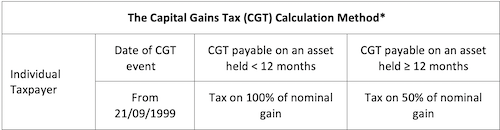
   

2. * A capital gain will be assessable in the financial year it is crystallised.

3. If appropriate, consider deferring the sale of an asset with an expected capital gain (and applicable capital gains tax liability) to a future financial year. By doing this, you could help reduce your personal income tax for the current financial year. This could also be of benefit if, for example, you expect that your income will be lower in future financial years compared to the current financial year.

4. If appropriate, consider offsetting a crystallised capital gain with an existing capital loss (carried forward or otherwise) or bringing forward the sale of an asset currently sitting at a loss. By doing this, you could reduce your personal income tax for the current financial year. Note that a capital loss can only be used to offset a capital gain.

Accounts Payable (Creditors) 

- If you operate on an accruals basis and services have been provided to your business, ensure that you have an invoice dated June 30, 2023 or before, so you can take up the expense in your accounts for the year ended 30th June 2023.

Obligations that need to be considered in relation to the end of financial year. 

If you use a Motor Vehicle in producing your income you may need to:

  • Record Motor Vehicle Odometer readings at 30 June 2023
  • Prepare a log book for 12 continuous weeks if your existing one is more than 5 years old.
If you are in business or earn your income through a Company or Trust:
Employer Compulsory Superannuation Obligations:

The deadline for employers to pay Superannuation Guarantee Contributions for the 2022/23 financial year is the 28 July 2023.  However, if you want to claim a tax deduction in the 2022/23 tax year the super fund (or Small Business Superannuation Clearing House) must receive the contributions by 30 June 2023. Avoid making contributions at the last minute because processing delays could deny you a significant tax deduction in this financial year.

  • For Private Company - Div 7A Loans  - Business owners who have borrowed funds from their company in prior years must ensure that the appropriate principal and interest loan repayments are made by 30 June 2023.
  • Trustee Resolutions - ensure that the Trustee Resolutions on how the income from the trust is distributed to the beneficiaries are prepared and signed before June 30, 2023 for all Discretionary (“Family”) Trusts.
  • Preparation of Stock Count Working Papers at June 30, 2023.
  • Preparation and reconciliation of Employee PAYG Payment Summaries (formerly known as Group Certificates). Note you are not required to supply your employees with payment summaries for amounts you have reported and finalised through Single Touch Payroll.

From 1 July 2023:

The compulsory Super Guarantee Contribution rate increases from 10.5 % to 11% from July 1, 2023.

Company Tax Rates For Small Business
  • The company tax rate for base rate entities with less than $50 million turnover was 25% for the 2021/22 year. This rate will remain at 25% for 2022/23 income year. A base rate entity is a company that both has an aggregated turnover less than the aggregated turnover threshold and 80% or less of their assessable income is base rate entity passive income.
  •  

Other Tax effective Strategies For Businesses

THE FOLLOWING SHOULD ALSO BE CONSIDERED
  • Stock Valuation Options - Review your Stock on Hand and Work in Progress listings before June 30 to ensure that it is valued at the lower of Cost or Net Realisable Value. Any stock that is carried at a value higher than you could realise on sale (after all costs associated with the sale) should be written down to that Net Realisable Value in your stock records.
  • Write-Off Bad Debts – If you operate on an accruals basis of accounting (as distinct from a cash basis) you should write-off bad debts from your debtors listing before June 30. A bad debt is an amount that is owed to you that you consider is uncollectable or not economically feasible to pursue collection. Unless these debts are physically recorded as a ‘bad debt’ in your system before 30th June 2023, a deduction will not be allowable in the current financial year.
  • Repairs and Maintenance Costs  – Where possible and cash flow allows, consider bringing these repairs forward to before June 30. If you don’t understand the distinction between a repair and a capital improvement please consult with us because some capital improvements may not be tax-deductible in the current year and could be claimable over a number of years as depreciation.
  • Obsolete Plant and Equipment - should be scrapped or decommissioned prior to June 30, 2023 to enable the book value to be claimed as a tax deduction.
  • Use of a Bucket Company to receive distributions from your Discretionary Trust 

Superannuation Tax Planning Opportunities

INCREASE IN SUPER GUARANTEE CONTRIBUTION RATE.  From July 1, 2023 the compulsory Super Guarantee Contribution rate increases from 10.5 % to 11%.

The maximum super contribution base used to determine the maximum limit on any individual employee's earnings base for each quarter of 2022/22 is $58,920 and for 2022/23 is $60,220 per quarter. You do not have to provide the minimum support for the part of earnings above this limit.

CONCESSIONAL CONTRIBUTION CAP OF $27,500 FOR EVERYONE

The tax-deductible superannuation contribution limit or cap is $27,500 for all individuals regardless of their age for the 2022/23 financial year.

  • If eligible and appropriate, consider making the most of your 2022/23 financial year annual concessional contributions cap with a concessional contribution. Note that other contributions such as employer Superannuation Guarantee Contributions (SGC) and salary sacrifice contributions will have already used up part of your concessional contributions cap. If your total superannuation balance as at June 30, 2022 was less than $500,000 you may be in a position to carry-forward unused concessional caps starting from the 2018/19 financial year. Members can access their unused concessional contributions caps on a rolling basis for five years and amounts carried forward that have not been used after five years will expire. The 2019/20 financial year was the first year in which you could access unused concessional contribution and by making a concessional contribution to your super, you could reduce your personal income tax for this financial year and provide for your future retirement.

Non-Concessional Contributions Cap

  •  If eligible and appropriate, consider utilizing all or part of your 2022/23 financial year annual non-concessional contributions cap by making a non-concessional contribution. If you are not currently in a non-concessional contributions bring forward period, consider whether you may be in a position to ‘bring-forward’ your non-concessional contributions caps for the 2023/24 and 2024/25 financial years, and contribute up to $330,000 for the 2022/23 financial year.
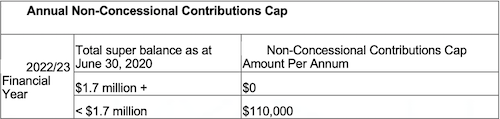
  • A non-concessional contribution generally refers to an after-tax contribution that isn’t (or can’t be) claimed as a tax deduction by the contributor, e.g. personal contributions not claimed as a tax deduction and spouse contributions (for the recipient).
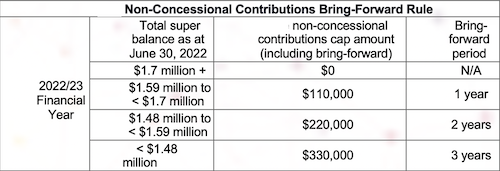
  • The advantage of making the maximum tax-deductible superannuation contribution before June 30, 2023 is that superannuation contributions are taxed at between 15% and 30%, compared to personal tax rates of between 32.5% and 45% (plus 2% Medicare levy) for an individual taxpayer earning over $45,000. Typically, self-employed individuals and those who earn their income primarily from passive sources like investments make their super contributions close to the end of the financial year to claim a tax deduction. However, individuals who are employees may also use this strategy and those who might want to take advantage of this opportunity would typically include individuals:
    • who work for an employer that does not permit salary sacrifice,
    • who work for an employer that does enable salary sacrifice (but it is not disadvantageous due to a reduction in entitlements), and
    • who are salary sacrificing but want to make a top-up contribution to utilise their full concessional contributions cap.

GOVERNMENT CO-CONTRIBUTION TO YOUR SUPERANNUATION

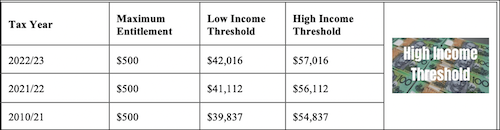
The Government co-contribution is designed to boost the superannuation savings of low and middle-income earners who earn at least 10% of their income from employment or running a business. If your income is within the thresholds listed in the table below and you make a ‘non-concessional contribution’ to your superannuation, you may be eligible for a Government co-contribution of up to $500. To be eligible you must be under 71 years of age as at June 30, 2022. In 2022/23, the maximum co-contribution is available if you contribute $1,000 and earn $42,016 or less. A lower amount may be received if you contribute less than $1,000 and/or earn between $42,016 and $57,016.
SALARY SACRIFICE TO SUPERANNUATION

If your marginal tax rate is 19% or more, salary sacrificing can be an effective way to boost your superannuation and also reduce your tax. By putting pre-tax salary into superannuation instead of having it taxed at your marginal tax rate you may save tax. This can be particularly beneficial for employees approaching retirement age.
 

Immediate Write-Off for Individuals Small Business Assets

Temporary Full Expensing allows businesses to claim an immediate deduction for the business portion of the cost of an asset being eligible plant, equipment and motor vehicles in the year it is first used or installed ready for use for a taxable purpose. For the 2022-23 income year, a business can claim an immediate deduction for the business portion of the cost of:

  • Eligible new assets first held, first used or installed and ready for use for a taxable purpose between 7.30pm AEDT on 6 October 2020 and 30 June 2023.
  • Eligible second-hand assets for businesses with aggregated turnover under $50 million - eligible depreciating assets using the simplified depreciation rules (only for small businesses with aggregated turnover of less than $10 million and less than $2 million for previous income years) and the balance of their small business pool.

If you are a small business entity that chooses to use the simplified depreciation rules, temporary full expensing rules apply with some modifications.

You cannot opt out of temporary full expensing for assets that the simplified depreciation rules apply to. You must immediately deduct the business portion of the asset’s cost for assets you start to hold, and first use (or have installed ready for use) for a taxable purpose from 7.30pm (AEDT) on 6 October 2020 to 30 June 2023. You don’t add these assets to your small business pool.

You may also deduct the balance of the small business pool at the end of an income year ending between 6 October 2020 and 30 June 2023.

Here are some key points to consider:

  • For the instant asset write-off the asset can be new or second-hand.
  • To be eligible, the asset must be purchased by a business turning over less than $50m or $500 million after 12th March 2020.
  • The amount must be under $150,000 (depending on date of purchase – it could be $30K or $25K or $20K) exclusive of GST (i.e. $165,000, $33K, $27.5K or $22K including GST)
  • If you borrow to purchase the asset, the asset is still eligible.
  • The asset must be installed and ready to use by the deadline.
  • To claim the write off on a motor vehicle you will need to have a valid log book and claim only that percentage of the cost as an immediate write off.
  • If you purchase a car for your business, the instant asset write-off is limited to the business portion of the car limit of $64,741 for the 2022/23 income tax year.
  • Any attempt to manipulate invoices etc. will attract the ATO's use of the anti-avoidance rules, thereby eliminating the write off.
  • If your business has a small profit or even a loss, the write off will be of little or no benefit in the current year (losses are not refundable but can be carried forward to the next year).
  • Building structural improvements are not eligible for the instant write-off.
  • If your business is not a ‘Small Business Entity’ you will need to depreciate all assets purchased over $1,000. Any assets purchased for $1,000 or less can be written off immediately.

Accelerated Depreciation Deductions

Newly-acquired depreciating assets valued at more than $30,000 (or $150,000 post 12th March 2020) and not applied to the instant asset write-off deduction can be added to the general business pool. As part of the backing business incentive, an accelerated depreciation deduction of 57.5 percent for the business portion of the new depreciating asset applies for the cost of an asset on installation from 12th March 2020 to 30th June 2023 and existing depreciation rules apply (15 per cent for the first year and 30 per cent for subsequent years) to the balance of the asset’s cost and for subsequent years. There is no limit to the cost of a qualifying depreciating asset eligible for this concession, but the asset must be new and not second-hand.

Hot Issues

Craig Byron

Lorem ipsum dolor sit amet, consectetur adipiscing elit. Fusce efficitur ligula id justo blandit, sit amet accumsan magna scelerisque. Phasellus tincidunt ipsum nec semper sagittis. Suspendisse suscipit, orci sed gravida dapibus, elit est porta ligula, vel convallis metus urna et ante. Pellentesque aliquam erat sodales sem blandit, ac facilisis magna mattis. Aliquam id lorem eu mauris bibendum facilisis in sit amet leo.

Morbi non ante vitae velit vehicula vehicula vitae euismod ex. Ut pretium rhoncus lacus in tincidunt. Suspendisse vulputate, diam eget viverra feugiat, magna velit scelerisque velit, vel posuere eros sem ut felis. Sed pellentesque justo in eros iaculis, et consequat nibh sollicitudin. Ut facilisis sit amet turpis sed cursus. Sed tincidunt neque arcu, a rutrum lectus elementum quis.

Vivamus nisi lectus, malesuada vel maximus a, lobortis in justo. Donec turpis diam, consectetur eu justo ut, accumsan malesuada nisl.

Tax and BAS returns

Taxation

The implementation of effective tax strategies is an integral part of the financial planning process. Structuring the way in which you receive your salary, superannuation contributions, investments, risk and debt management can significantly minimise your tax implications and are an essential component of your wealth creation and retirement strategy.
At Clear Picture, we want you to accomplish your financial objectives in the most tax-efficient manner as other aspects of your financial plan become easier to implement when your tax liability is minimised.
Our strategies are tested, proven and successful. We offer a broad range of taxation advisory services including:
  • Income Tax
  • Capital Gains Tax (CGT)
  • Superannuation & Transition To Retirement
  • Salary Packaging and Fringe Benefits Tax (FBT)
  • Land Tax and Stamp Duty
  • There are numerous tax effective financial planning strategies that may be appropriate for your circumstances and enhance your tax, retirement and wealth objectives. Contact our team to discuss the possibilities.

---------------------

BAS

Lodging your BAS correctly and on time can be a difficult and confusing process. You can avoid risk and stress simply by being confident that your ATO tax liabilities and obligations are sorted and your BAS lodgement is correct every time.
It’s not surprising that peace of mind for many business owners comes with appointing an experienced agent to look after their BAS services for them.
Our friendly, service orientated team offer a range of BAS services and lodgement options to suit all small business owners so you have more time to do what you do best – running your business and earning money.
Services include:
  • Preparation of Business Activity Statements from business data
  • Electronic Lodgement of Business Activity Statements
  • Personalised advice on BAS provisions (including GST, PAYG, Withholdings and Instalments, Fringe Benefits Tax, Fuel Tax Credits and more)
  • Preparation of Instalment Activity Statements and Employee Payment Summaries
  • Management of financial data files and preparation of reports for business tax returns
  • Handle payroll and superannuation obligations including Reportable Employer Super Contributions
Contact Us

Accounting

Straight forward and stress-free accounting services are what businesses of all sizes need form their accountants and we believe we provide exactly that. By providing cutting edge accounting and taxation services, and using the right products for your record keeping, our team at XX will work closely with you to ensur we understand your needs. Only in this way can we help you achieve your goals, help you manage your cash flow and help you meet your tax obligations.
While fiscal compliance is of the upmost importance, we also believe in offering professional management advice and support at all times. We are committed to offering the highest level of friendly and professional service and welcome the opportunity to work with you.
The areas we specialise in are as follows:
  • Accounting & Tax Consultancy Services
    Straight forward and stress-free accounting services are what businesses of all sizes need form their accountants and we believe we provide exactly that. By providing cutting edge accounting and taxation services, and using the right products for your record keeping, our team at XX will work closely with you to ensur we understand your needs. Only in this way can we help you achieve your goals, help you manage your cash flow and help you meet your tax obligations.
    While fiscal compliance is of the upmost importance, we also believe in offering professional management advice and support at all times. We are committed to offering the highest level of friendly and professional service and welcome the opportunity to work with you.
    The areas we specialise in are as follows:
  • Accounting & Tax Consultancy Services
  • Personal & Business Tax Returns
  • Annual Reporting
  • Business and Tax Advisory
  • Business ‘start up’ advice
  • Prepare Business plans and financial budgets and review these regularly
  • Measure your performance against industry benchmarks
  • Trust & company structures
  • ATO correspondence Management
  • Taxation – GST & PAYE advice, BAS preparation
  • Liaise with the ATO on your behalf
  • Self-Managed Super auditing
  • Accounting software advice and assistance
  • Personal & Business Tax Returns
  • Annual Reporting
  • Business and Tax Advisory
  • Business ‘start up’ advice
  • Prepare Business plans and financial budgets and review these regularly
  • Measure your performance against industry benchmarks
  • Trust & company structures
  • ATO correspondence Management
  • Taxation – GST & PAYE advice, BAS preparation
  • Liaise with the ATO on your behalf
  • Self-Managed Super auditing
  • Accounting software advice and assistance

Bookkeeping and Payroll

Bookkeeping

Clear Picture can take over all, or some of your bookkeeping activities allowing you to concentrate on growing your business.
We can:
  • Design, establish and review accounting systems and software
  • Perform checks, reconciliations and end of financial year reports
  • Manage your accounts receivable and accounts payable
  • Ensure your business is up to speed with legislative requirements and management reports
  • Undertake payroll duties and compliance
  • Prepare and lodge BAS statements
  • GST & PAYE advice
  • BAS Lodgement
  • GST Reconciliation
  • PAYG Withholding & Superannuation reports
  • Completing expense reports
  • Direct to bank account transactions
  • Organising your documents and records
  • Data / ledger entry
  • Paying bills
  • Completing expense reports
  • Direct to bank account transactions
  • Provide general business administrative support

---------------------------

Payroll

We can assist you with all facets of payroll and reportable contractor payments. Our professional team are fully versed in all legislative requirements and the processes required in managing this crucial part of your business.
The primary objective of payroll processing is to ensure that employees receive all the financial entitlements they are owed in a timely manner.
Poor payroll processing can be very detrimental to a business as it can significantly impact net income and lead to disgruntled staff. With an abundance of legislation, payment methods and withholdings, payroll management can be a difficult and time-consuming process.
Payroll processing services include:
  • General Payroll – ensure your staff are paid the correct rates and paid according to the correct hours worked.
  • Payslips – Our team can prepare your staffs payslips on your behalf and email them directly to you or your staff along with
  • PAYG Withholdings – Any business that has employees or pays employees of another business must withhold an amount from payments made to them. Any payments made to a business that doesn’t quote an ABN on an invoice or other documentation must also have an amount withheld from payments.
  • Taxable payments reporting – Businesses in the building and construction industry need to report the total payments they make to each contractor for building and construction services each year. These payments need to be reported to the Australian Taxation Office (ATO) on the Taxable Payments Annual Report, or electronically.
  • Entitlements – calculation of leave including holiday, personal, long service and rostered days off.
  • Payroll Tax, Workers Compensation Insurance, Employment Forms – some or all of these may be needed for your business.
  • Efficient and Electronic systems – these should simplify all processing and provide greater security for you and your staff.
  • Superannuation should be calculated and paid – this is a compulsory whereby employers are required to pay a percentage on top of “ordinary time’s earnings” to a nominated superannuation fund. These contributions need to be made at least once every three months and penalties for late payment are very severe.
  • End of Payroll Year Processing – Reconciling, Generation and Lodgement of employment group certificate’s and payment summaries, taxable payment summaries, reportable fringe benefits and lump sum amounts

Business start ups

There are four main business structures commonly used by businesses in Australia and we can help with them all:
Sole trader: an individual operating as the sole person legally responsible for all aspects of the business.
Partnership: an association of people or entities running a business together, but not as a company. A partnership is relatively inexpensive to set up and operate.
Company: a legal entity that is separate from its shareholders.
Trust: an entity that holds property or income for the benefit of others. Trusts require a formal trust deed that outlines how the trust operates, requires the trustee to undertake formal yearly administrative tasks and if you operate your business as a trust, the trustee is legally responsible for its operations. A trustee of a trust can be a company, providing some asset protection.
It is important to note that you can change your business structure throughout the life of your business.
Before commencing a new business, the following are some of the key items that need to be considered:
  • Decide on the most suitable structure for your business – sole trader, partnership, trust or company
  • Prepare a business plan, cashflow projections, budgets, and trading forecasts
  • Assess your finance requirements, advise on the best sources of finance, and draw up the necessary proposals
  • Establish a good working relationship with your bank
  • Register for a Tax File Number and an Australian Business Number with the ATO
  • Complete registration procedures with Australian Securities and Investments Commission
  • Deal with company secretarial issues
  • Set up a recording system for your internal use and for complying with statutory requirements

Each new business is different and needs to be considered in relation to your individual circumstances and our experience can ensure you are maximising your opportunities.

Consulting

Tax & Accounting Consultancy Services

Management Accounting includes the preparation of management reports and accounts that provide accurate and timely financial and statistical information. Information required by managers to make day-to-day and short-term decisions more efficiently and effectively to achieve desired outcomes such as increasing profit or delivering improved services.
Unlike financial accounting, which produces tax returns and annual reports, management accounting generates monthly or weekly reports for an organization's management and decision makers. These reports typically show items such as available cash, sales revenue, orders in hand, accounts payable and accounts receivable, and outstanding debts. An important aspect of Management accounting is determining what information management needs and communicating this effectively.
Clear Picture can assist with all aspects of management reporting including:
  • Strategic advice to managers about the financial implications of projects
  • KPI reporting
  • Explaining the financial consequences of business decisions
  • Formulating business budgets and business plans and strategies
  • Monitoring spending, financial control and Cashflow projection
  • Conducting internal business audits
  • Monthly/quarterly management reports
  • Product costing reviews.

Tax advice, tax planning and structuring advice

Tax Planning

Tax time is coming up. Are you prepared?
When the time comes to deal with your own taxation and accounts, it can be stressful and hassling. Though through good preparation and planning, you can make tax time work for you and potentially reduce the impact of tax, while keeping up to date.
Clear Picture are specialists at accounting and taxation. Based in XXX, we aim to provide our clients with comprehensive tax planning advice and strategies, all at competitive prices.
We provide assistance for:
  • Individuals
  • Families
  • Artists
  • Trusts
  • Businesses and
  • Organisations (non-profit and commercial)

--------------

Tax Planning

Tax time is coming up. Are you prepared?
When the time comes to deal with your own taxation and accounts, it can be stressful and hassling. Though through good preparation and planning, you can make tax time work for you and potentially reduce the impact of tax, while keeping up to date.
Clear Picture are specialists at accounting and taxation. Based in XXX, we aim to provide our clients with comprehensive tax planning advice and strategies, all at competitive prices.
We provide assistance for:
  • Individuals
  • Families
  • Artists
  • Trusts
  • Businesses and
  • Organisations (non-profit and commercial)

--------------

Structure

A client needs to put in place the right strategies and structures, to create wealth and then review these strategies and structures on a regular basis. That is because your circumstances and goals will change and so will the economy and the legislation relating to how your affairs are structured.
There are many paths that may be more appropriate than others such as:
  • Selecting the best tax structure;
  • Using gearing;
  • Reducing debt;
  • Using Shares, managed funds or other types of assets. Indeed it may be a combination of many to properly meet your needs.

Rental properties

Like any form of business, property ownership can be less than hoped for. However, rental income, gearing, purchase, borrowings, management, appropriate structures, and advice are how XX help clients who rent commercial and residential properties.
Our aim is to ensure such investments generate the appropriate returns.
We assist in a variety of ways:
  • Advice on funding
  • Advice with purchasing
  • Cash flow analysis of property investment
  • Guidance in tax related areas including negative gearing and capital gains tax
  • Advice on ownership structures
  • Preparation of initial land tax returns and land tax variation returns

Trusts

Trust Advice

A trust provides a valuable way of protecting the assets you have accumulated for the benefit of yourself and others. A trust can also be an effective structure for running your business.
We have extensive experience with trusts and are able to offer specialist advice on establishment and compliance, ensuring that all statutory requirements are met.
Clear Picture are also able to organise for the preparation and execution of documentation involved in Trust formation.
Our Trust administration service includes:
  • Minute keeping service
  • Annual accounts
  • Taxation
  • Maintenance of CGT register
  • Income distribution
We know the issues and requirements involved with managing Trusts and can help ensure these tasks are undertaken properly.

NZ Clients and temporary residency

NZ Clients and temporary residency

Clear Picture help New Zealand individuals and businesses — including temporary residents and recent arrivals — manage tax, compliance and financial planning so you can focus on settling in and growing your activities.

Services for NZ clients & temporary residents

  • Tax residency assessment and advice (determine NZ tax residency and obligations)
  • Income tax planning for residents and part-year taxfilers
  • PAYE, GST and IRD registration and compliance
  • Withholding taxes, foreign income disclosure and double tax relief guidance
  • Property tax, rental income and bright-line rule support
  • KiwiSaver advice, provisional tax and payroll setup for employers
  • Cross-border structuring and tax-efficient repatriation of funds
  • End-of-year tax returns, tax credits, and liaison with Inland Revenue

Get in touch for a tailored consultation to clarify your NZ tax position and compliance obligations.

Tax Diary

General Calculators


Accounting Videos

Secure File Transfer

Secure File Transfer is a facility that allows the safe and secure exchange of confidential files or documents between you and us.

Email is very convenient in our business world, there is no doubting that. However email messages and attachments can be intercepted by third parties, putting your privacy and identity at risk if used to send confidential files or documents. Secure File Transfer eliminates this risk.

Login to Secure File Transfer, or contact us if you require a username and password.

General Disclaimer

All care is taken in the preparation of the information and published on this website. Clear Picture Tax & Accounting does not make any representations or give any warranties about its accuracy, reliability, completeness or suitability for any particular purpose.

To the extent permissible by law, Clear Picture Tax & Accounting will not be liable for any expenses, losses, damages (including indirect or consequential damages) or costs which might be incurred as a result of the information being inaccurate or incomplete in any way and for any reason.

If you have any concerns regarding the content of the website, please contact us.

Privacy Policy

Clear Picture Tax & Accounting is committed to providing quality services to you and this policy outlines our ongoing obligations to you in respect of how we manage your Personal Information.

We have adopted the Australian Privacy Principles (APPs) contained in the Privacy Act 1988 (Cth) (the Privacy Act). The NPPs govern the way in which we collect, use, disclose, store, secure and dispose of your Personal Information.

A copy of the Australian Privacy Principles may be obtained from the website of The Office of the Australian Information Commissioner at https://www.oaic.gov.au/.

What is Personal Information and why do we collect it?

Personal Information is information or an opinion that identifies an individual. Examples of Personal Information we collect includes names, addresses, email addresses, phone and facsimile numbers.

This Personal Information is obtained in many ways including correspondence, by telephone and facsimile, by email, via our website, from your website, from media and publications, from other publicly available sources, from cookies and from third parties. We don't guarantee website links or policy of authorised third parties.

We collect your Personal Information for the primary purpose of providing our services to you, providing information to our clients and marketing. We may also use your Personal Information for secondary purposes closely related to the primary purpose, in circumstances where you would reasonably expect such use or disclosure. You may unsubscribe from our mailing/marketing lists at any time by contacting us in writing.

When we collect Personal Information we will, where appropriate and where possible, explain to you why we are collecting the information and how we plan to use it.

Sensitive Information

Sensitive information is defined in the Privacy Act to include information or opinion about such things as an individual's racial or ethnic origin, political opinions, membership of a political association, religious or philosophical beliefs, membership of a trade union or other professional body, criminal record or health information.

Sensitive information will be used by us only:

Third Parties

Where reasonable and practicable to do so, we will collect your Personal Information only from you. However, in some circumstances we may be provided with information by third parties. In such a case we will take reasonable steps to ensure that you are made aware of the information provided to us by the third party.

Disclosure of Personal Information

Your Personal Information may be disclosed in a number of circumstances including the following:

Security of Personal Information

Your Personal Information is stored in a manner that reasonably protects it from misuse and loss and from unauthorized access, modification or disclosure.

When your Personal Information is no longer needed for the purpose for which it was obtained, we will take reasonable steps to destroy or permanently de-identify your Personal Information. However, most of the Personal Information is or will be stored in client files which will be kept by us for a minimum of 7 years.

Access to your Personal Information

You may access the Personal Information we hold about you and to update and/or correct it, subject to certain exceptions. If you wish to access your Personal Information, please contact us in writing.

Clear Picture Tax & Accounting will not charge any fee for your access request, but may charge an administrative fee for providing a copy of your Personal Information.

In order to protect your Personal Information we may require identification from you before releasing the requested information.

Maintaining the Quality of your Personal Information

It is an important to us that your Personal Information is up to date. We will take reasonable steps to make sure that your Personal Information is accurate, complete and up-to-date. If you find that the information we have is not up to date or is inaccurate, please advise us as soon as practicable so we can update our records and ensure we can continue to provide quality services to you.

Policy Updates

This Policy may change from time to time and is available on our website.

Privacy Policy Complaints and Enquiries

If you have any queries or complaints about our Privacy Policy please contact us at:

admin@clearpictureaccounting.com.au

1300 438 008